



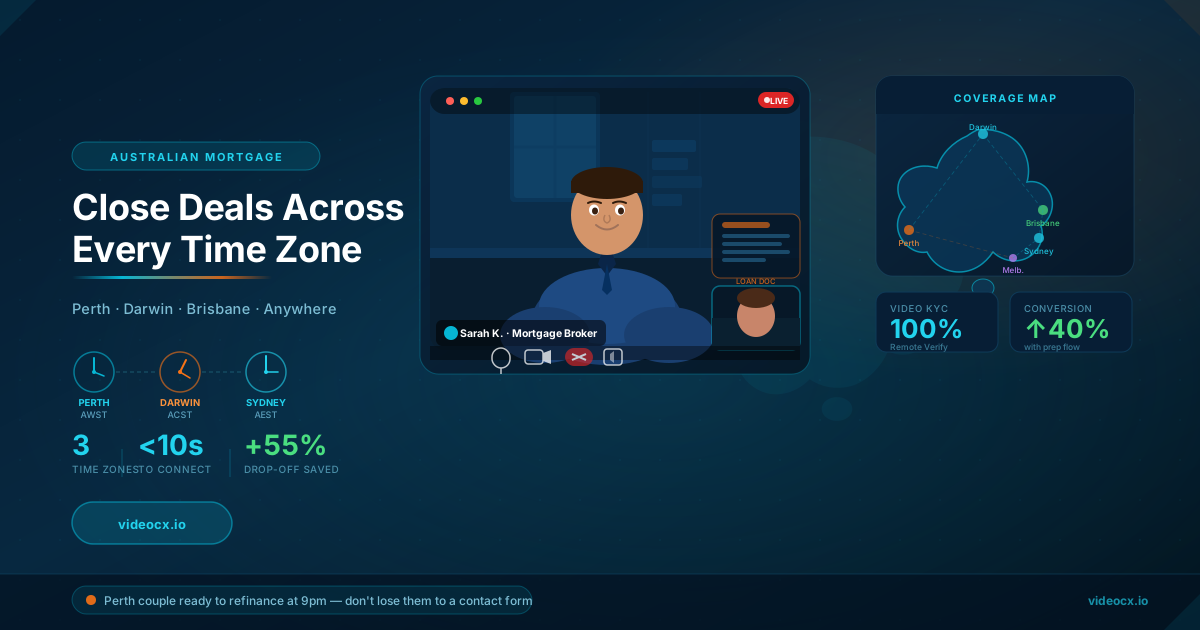
A couple in Perth finalises their decision to refinance at 9pm on a Wednesday. They are ready. They go to your website, see no way to connect right now, and fill in a contact form. By the time you call them Thursday morning, they have already spoken to someone else.
This is not a rare situation. It is the structural reality of running a mortgage business across a country that spans three time zones, where both adults in most households work full-time, and where digital-first expectations have completely rewritten when and how people want to engage with financial services.
The conversion problem for Australian mortgage brokers is not really about rates or expertise. It is about availability, speed, and the ability to build trust with someone you may never meet in person. Video, done properly, solves all three.
Why Time Zones Hurt Conversion More Than Brokers Realise
Most brokers think of the time zone problem as a scheduling inconvenience. It is actually a conversion problem.
When a client in Darwin is ready to talk at 7pm, and your office closes at 5pm Melbourne time, that is a two-hour window where intent exists but no connection is possible. Multiply that across a client base spread from Broome to Brisbane, add the FIFO workers only reachable on certain days, the interstate investors juggling busy schedules, and the first-home buyers who can only focus on this after they put the kids to bed, and you are looking at a significant portion of your potential conversions happening outside the window you are available for them.
The traditional response has been to ask clients to book a time. But a scheduler adds friction at the exact moment when intent is highest. Every step between a client deciding they want to talk to you and actually talking to you is a chance for them to talk to someone else instead.
The brokers closing more of these moments are not working longer hours. They have built a video infrastructure that connects clients to the right conversation fast, removes the scheduling barrier, and keeps the process moving regardless of what time it is or where the client is sitting.
Video Is Not a Communication Tool. It Is a Trust Infrastructure.
There is a version of video that does not work: dropping a Zoom link in an email and hoping the client shows up. That is just a phone call with a camera. It does not reduce friction, does not build trust faster, and does not help you serve someone in a different time zone any better than a phone call would.
What actually works is video that is woven into every stage of the client journey, from the moment they first reach out to the day they sign. Each touchpoint designed to reduce effort for the client, move the process forward, and reinforce that they are working with someone professional and organised.
Think about what a mortgage client is actually going through. They are making one of the largest financial decisions of their life, often under time pressure, often while juggling work and family. The broker who makes that process feel manageable, who turns up as a calm and knowledgeable presence exactly when the client needs them, wins the relationship. Video is how you do that at scale, across distances, across time zones, without being physically present.
Where Video Actually Changes the Game for Mortgage Brokers
Here is where a proper video setup shifts outcomes across the mortgage journey, and why each stage matters.
The First Connection: Speed Over Scheduling
When a client reaches out, the window to capture their attention is short. The broker who connects fastest, not fastest to send an email, but fastest to have an actual conversation, wins a disproportionate share of new business.
A video platform with smart customer journey routing connects a client to the right mortgage specialist in under 10 seconds. No scheduling. No waiting until tomorrow. The client arrives with intent, and they leave having spoken to a human expert who understood exactly what they needed. That is a fundamentally different first impression than a contact form acknowledgement.
And because routing is intelligent, a first-home buyer asking about borrowing capacity does not land in the same queue as a property investor asking about a self-managed super fund loan. The right client reaches the right person. Conversations are better. Outcomes are faster.
Identity Verification: Remove the Trip to the Branch
For any client outside your city, the identity verification step in a mortgage application has traditionally meant either posting certified documents, driving to a branch, or navigating a clunky digital portal that half the time does not work on their phone.
Video KYC removes all of that. Clients verify their identity through a secure, recorded video session without leaving their home. The session is timestamped, compliant, and audit-ready. For a broker with clients across Western Australia, Queensland, and the Northern Territory, this changes the economics of onboarding entirely. You stop losing clients at step one because the process was too hard.
The Credit Conversation: Replace Email Chains With Real Dialogue
Walking a client through their financial position over email is slow, confusing, and surprisingly easy to misread. Documents arrive in the wrong format. Questions get buried. The back-and-forth drags on for days when it could be resolved in a single conversation.
Credit assessment and document verification over video puts the broker and client together in a live session where the financial picture is built in real time. The broker can ask follow-up questions immediately. The client can see someone walking them through what the numbers mean and why. That kind of guided, face-to-face process builds confidence in the broker and moves the application forward faster than any email thread ever could.
The Advisory Stage: Presence Without Being There
The loan recommendation is the most trust-sensitive moment in the broker relationship. This is where the client decides whether they actually believe you are acting in their interest or just pushing a product. A phone call can get this done. Video does it better.
In a dedicated video banking environment, the broker and client are in a professional, branded space. The broker can walk through loan comparisons on screen. The client can see the broker’s face as they explain the trade-offs. Tone, body language, and presence all contribute to trust in ways that a voice call simply cannot replicate. For a client in Cairns who will never walk into your office, this is the closest thing to sitting across the table from you.
One detail worth noting: a good video platform also works from a browser, not just inside a bank or broker app. Over 60% of people look up their financial service needs from a standard browser without ever logging into an app. If your video capability only works inside an app, you are invisible to the majority of the clients who are actively looking for you.
What Actually Kills Conversion in a Video Journey, and How to Fix It
Getting clients onto video is only half the challenge. The other half is keeping them there long enough to complete the process. There are two specific failure points that kill conversion in video-based mortgage journeys, and both are fixable.
The unprepared client. A client who joins a video session without the right documents, in a dark room on a patchy connection, is going to have a frustrating experience. Video platforms that display dynamic instructions before the call begins, telling clients what to have ready, where to sit, and what to expect, see a 40% higher success rate on those calls. It is a small thing that makes an outsized difference.
The dropped connection. Regional Australia has variable connectivity. A call that drops halfway through a credit assessment is not just an inconvenience. It can mean starting the conversation over, losing momentum, and occasionally losing the client entirely. Platforms with a parallel chat connection keep the session alive even when the video drops. The broker and client can rejoin the video call within the same session, without losing the thread of the conversation. This reduces session drop-offs by over 55%.
Both of these details matter more than most brokers realise, because conversion is not just about whether a client shows up to a call. It is about whether the call actually completes successfully.
You Cannot Improve What You Cannot See
Most brokers have a rough sense of their conversion rate. They know how many leads came in this month and how many settled. What they typically do not know is where in the journey clients are falling out, which parts of the process are creating friction, and which brokers on their team are closing at a higher rate and why.
Live dashboards and reporting built into the video platform change this. You can see real-time client traffic, track where drop-offs are happening across the digital journey, monitor how sessions are being handled by different team members, and measure outcomes by product type. That data turns video from a communication channel into a genuine business intelligence tool. You see what is working, fix what is not, and make staffing and process decisions based on actual client behaviour rather than gut feel.
What Better Video Actually Does to Your Numbers
This is worth being direct about. Brokers who invest in a proper video infrastructure, not a Zoom link but an end-to-end platform, see measurable differences in their outcomes.
- Faster time to first conversation means fewer leads lost to competitors who responded sooner.
- Fewer drop-offs during verification and assessment means more applications reaching completion.
- Higher trust earlier in the relationship means clients are less likely to shop around after the first conversation.
- Better client experience means more referrals. A client who felt supported through a complex process tells their colleagues about it. Not just that you found them a good rate. That you were easy to work with.
There is also the cross-sell angle. A client who is already in a video session discussing their mortgage is an ideal candidate to hear about an offset account, a protection product, or a fixed rate option they had not considered. Brokers using video well at this stage are seeing meaningful new product uptake without any additional acquisition cost.
Conversion Does Not Care What Time It Is
Australian mortgage brokers who are growing right now are not necessarily the ones with the biggest marketing budgets or the most competitive rates. They are the ones who are available when clients are ready, who make a complicated process feel manageable, and who build trust quickly enough that clients stop looking elsewhere.
Time zones are a constraint. Video is how you work within them without burning out or losing the deals that happen outside business hours. The key is not just using video. It is using it end to end, with the right platform, so that every stage of the journey is as smooth for a client in Broome at 9pm as it is for someone walking into your Sydney office at 10am.
The infrastructure exists. The question is whether your current setup is actually built to convert.
Frequently Asked Questions
Do clients need to download anything to join a video call?
No, and this matters more than it might seem. A browser-based video experience means clients can connect directly from a link without installing an app or logging into a portal. Given that the majority of people research financial services from a standard browser, making video accessible this way significantly increases the number of clients who actually use it.
What if the connection drops during a sensitive part of the conversation?
A platform with parallel chat keeps the session open even if the video drops. Both parties can rejoin the video call within the same session. This is especially relevant for clients in regional or rural areas where connectivity is less reliable, and it removes one of the most common reasons a video-based mortgage journey fails to complete.
How is identity verification handled for interstate clients?
Video KYC allows clients to verify their identity through a recorded, compliant video session from wherever they are. No branch visit required, no certified document posting. For a broker whose clients are spread across multiple states, this is one of the highest-impact changes you can make to your onboarding process.
Is video only useful for the initial consultation?
No. The most effective use of video across a mortgage journey is end to end: first contact and routing, identity verification, credit and document assessment, loan advisory, and purchase confirmation. Each stage benefits from video in a different way, and keeping the client in a consistent, professional video environment throughout builds more trust than switching between channels at each step.
How do I know which parts of my video journey are causing drop-offs?
Live dashboards built into a proper video platform show you exactly where clients are exiting the process, how long they are spending at each stage, and how different sessions are converting. This visibility is what turns a video setup from a communication tool into something you can actually optimise over time.
Is this relevant for a smaller brokerage or just larger operations?
It is arguably more relevant for smaller brokerages. A solo broker or small team cannot be available around the clock through traditional means. A video infrastructure that routes clients instantly, handles verification, and keeps sessions running smoothly effectively multiplies your capacity without multiplying your headcount.