





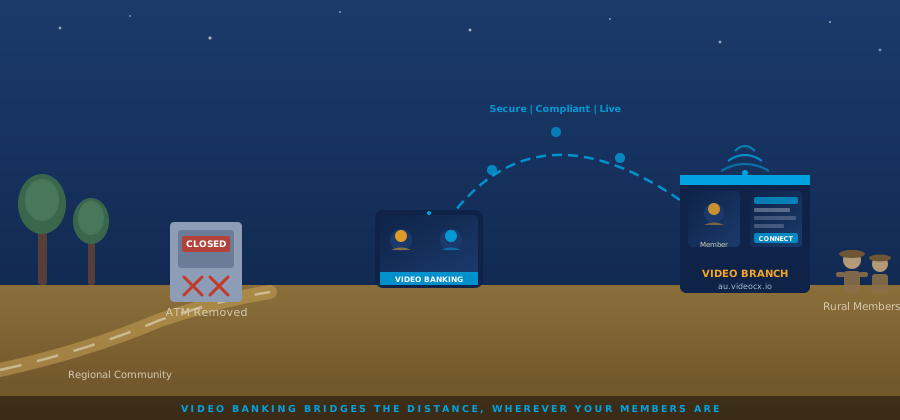
Picture this: you’re a farmer outside Broken Hill. The nearest credit union branch closed two years ago. The ATM that replaced it was pulled last December. The next town with a bank is a 90-minute drive down a dirt road. And you need to refinance a tractor loan before the season starts.
This is not a hypothetical scenario. It is playing out in hundreds of communities across regional and rural Australia right now. And credit unions are quietly finding a way through it with video.
The Quiet Crisis Hitting Regional Credit Unions
Australia’s regional banking footprint has been shrinking for years. ATMs are disappearing at an accelerating rate. The big four banks alone removed thousands of machines between 2017 and 2024. Branches in towns with fewer than 5,000 people are increasingly unviable on a cost-per-transaction basis.
For the major banks, a retreating rural presence is painful but survivable. For credit unions and mutual banks, it’s existential. Their whole reason for existing is to serve communities that would otherwise be underserved. If they leave too, there’s nobody left.
> More than 600 Bank branches closed across Australia since 2017
> 30%+ Of rural residents now 20+ km from a branch
> 1 in 4 Regional Australians report difficulty accessing financial services
Credit unions feel this acutely. Many of their members are older, less digitally confident, and genuinely need a conversation, not just an app. Yet the economics of maintaining a physical presence in every small town simply don’t stack up anymore.
That gap, between what members need and what branches can deliver, is exactly where video is stepping in.
What Video Banking Actually Means in Practice
When most people hear “video banking,” they picture a Zoom call with a bank teller. That’s part of it, but only the surface layer.
What regional credit unions are actually deploying is a full-service video branch and video banking infrastructure. Think of it as everything a physical branch can do, including account opening, loan applications, financial counselling, hardship conversations, and term deposit renewals, delivered via a secure, compliant, recorded video channel.
A member in Longreach can sit down with a specialist lending officer based in Brisbane. A retiree in Mildura can get estate planning guidance from an expert they’d previously have needed to drive two hours to see. A first-home buyer in Kalgoorlie can walk through a mortgage comparison with a human being who actually knows their name.
That is the practical power of video for credit unions. It doesn’t replace the relationship. It preserves it, even when the economics of a physical presence no longer hold.
Onboarding New Members Without a Branch in Sight
One of the stickiest problems for any financial institution is identity verification. How do you know the person applying for an account is who they say they are? Historically, the answer was: they walk into a branch with their passport and a utility bill.
In a region where the nearest branch is gone, that process breaks completely. And simply moving to a digital form doesn’t solve it. Identity fraud risk remains, and regulators still require robust AML and KYC compliance.
This is where video KYC is changing the game for rural credit unions. Instead of making a member travel, a video KYC session lets a staff member verify identity documents in real time, on screen, with the member present. The session is recorded, timestamped, and compliance-ready. It meets AUSTRAC requirements without anyone getting in a car.
For a credit union trying to grow membership in a town that has had its branch stripped away, this is transformative. New members can join properly, with all the compliance checks done, from wherever they happen to be.
The Problem with “Just Use the App”
There’s a well-meaning but often tone-deaf response when branches close: “Members can just use digital banking.” And yes, for simple transactions like checking a balance or transferring funds, that’s true.
But regional Australia has specific, compounding challenges that make “just go digital” insufficient:
- Connectivity gaps: large swaths of rural Australia still don’t have reliable broadband or mobile coverage. Any video solution needs to perform on low-bandwidth connections.
- Age demographics: regional credit union membership skews older than metro averages. Many members are deeply uncomfortable with apps and online portals. They want to speak to a person.
- Complexity of need: farming businesses have complicated financial lives. Seasonal lending, agribusiness finance, and drought support require nuanced conversations, not form-filling.
Video banking addresses all three. It is a human channel, which meets members where their comfort sits, delivered remotely, which solves the distance problem.
Verifying Income and Documents When You Are 400km Apart
Rural borrowers often have complex income profiles. A mix of farm income, off-farm wages, seasonal variation, government support payments, and equipment depreciation schedules. Assessing that over a digital form is genuinely difficult.
Forward-thinking credit unions are using credit verification via video PD sessions where a lending officer can walk through financial documents with the member in real time, sharing screens, reviewing payslips and Business Activity Statement (BAS) statements, and asking questions as documents come up. It makes the credit assessment process feel like a consultation, not an interrogation.
For members who’ve had their requests knocked back by algorithmic assessors at the big banks, this kind of human engagement isn’t just better service. It is often the difference between accessing finance and going without.
Getting the Right Member to the Right Person, Faster
One underrated challenge in video banking is routing. When a member initiates a video call, how does the system know whether to connect them to a lending specialist, a general service officer, or a financial counsellor? Get it wrong and you’ve wasted their time, which is the one thing rural members who’ve already driven to an agent location or fought for signal really don’t have to spare.
Sophisticated customer journey and routing tools solve this by asking smart intake questions before the video session starts. The member selects their need, the system routes them intelligently, and the specialist who picks up already knows the context. No “let me transfer you.” No starting the story again from scratch.
For credit unions managing staff across multiple locations, this also allows genuinely flexible workforce models. A lending specialist in Dubbo can serve members from Tamworth, Orange, and Griffith simultaneously, without any of those members knowing or caring where the specialist physically sits.
Real-World Scenario
A member in outback Queensland needs to discuss a hardship arrangement on her home loan. She accesses the credit union’s video portal via her tablet. Smart routing identifies her as an existing borrower with a flagged account. She’s connected directly to a hardship specialist, not a general teller. The specialist already has her file open. The conversation takes 22 minutes. No travel. No wait. No being passed around.
Proving the Model Works: Dashboards and Accountability
Credit union boards and regulators aren’t going to take “video banking is great” on faith. They want data. What’s the average handling time? Which services are being accessed most? Are members in specific postcodes getting equitable access? Is NPS improving?
This is why dashboards and reporting aren’t just a nice operational feature. They are a governance requirement. Credit unions using VideoCX.io can pull real-time data on session volumes, wait times, member satisfaction scores, resolution rates, and regional access patterns. When the board asks whether the digital inclusion strategy is working for members in far western New South Wales, the answer is a chart, not a guess.
This accountability layer also matters for external stakeholders. APRA and ASIC are increasingly interested in how financial institutions are managing access obligations. Being able to demonstrate, with data, that rural members are getting equivalent service quality to metro members is a powerful compliance and reputational asset.
This Is Not the Future. It Is Already Happening.
Several Australian credit unions and mutual banks are already deep into video banking deployments. Regional members are having mortgage interviews via video. Agribusiness loan applications are being assessed remotely. Financial counselling is being delivered to isolated communities that haven’t had face-to-face access to a financial professional in years.
The question for credit union leadership is no longer “should we investigate video banking?” It’s “how far behind are we, and what does catch-up look like?”
The good news: the infrastructure exists, the compliance frameworks are established, and the member appetite, especially in regional Australia, is demonstrably there. Rural members don’t need convincing that the branch is gone. They are already living with the consequences. What they need is to know you’ve found a real replacement, not just a digital form and a 1300 number.
Video isn’t a workaround. For regional and rural credit unions, it might just be the most important strategic investment of this decade.
Frequently Asked Questions
Is video banking actually secure for sensitive financial discussions?
Yes. Purpose-built video banking platforms like VideoCX.io use end-to-end encryption, session recording with access controls, and compliance-grade audit trails. They are fundamentally different from consumer video tools like Zoom or Teams, which are not designed to meet AUSTRAC or APRA requirements. Every session is recorded, stored securely, and retrievable for compliance purposes.
What happens if a rural member has poor internet connectivity?
Good video banking platforms are optimised for low-bandwidth environments and automatically adapt video quality to the available connection. Many credit unions also deploy video-enabled kiosks or agent locations, like a local post office or council building, where members can walk in and access a high-quality video connection without needing home broadband.
Can video banking replace all branch functions?
Almost all advisory and service functions, yes. Account opening, lending, financial counselling, KYC, and document review are all fully deliverable via video. Cash handling is the one genuine exception, which is why credit unions pair video banking with ATM partnerships, Bank@Post, and agency banking arrangements for physical cash access.
How long does it typically take to deploy video banking for a regional credit union?
With a specialist provider like VideoCX.io, most credit unions are live within 8 to 12 weeks. This includes platform configuration, staff training, compliance documentation, and member communications. The phased approach typically starts with lending and then expands to full member service and onboarding.
Are older or less tech-savvy members actually willing to use video banking?
More than you’d expect, especially when the alternative is a very long drive. The key is the interface design and how the member is introduced to it. Credit unions that deploy tablet or kiosk-based access points at familiar community locations, such as chemists, rural stores, or post offices, see strong adoption even among older demographics. When the interface is “press here to speak to someone,” most members engage readily.
Does video banking meet AUSTRAC KYC and AML requirements?
Yes. Video KYC conducted through a compliant platform meets AUSTRAC’s identification and verification requirements when done correctly, including document inspection, liveness verification, and session recording. VideoCX.io’s platform is specifically built with Australian regulatory requirements in mind, and the compliance documentation is designed to withstand audit scrutiny.