



A 38-year-old tradesman in regional Queensland needs income protection cover. He has a history of a back injury from five years ago, a period of anxiety he managed through his GP, and a self-employed income that fluctuates by season. He fills out a digital application form and abandons it halfway through. The questions feel clinical. He does not know how to describe his history in a way that will not get him declined. He gives up and stays uninsured.
Six months later, he injures his back on a job. He has no cover.
This is Australia’s underinsurance problem in miniature. And the form was not the real problem. The conversation was.
A Financial Services Council report found that an estimated one million Australians are underinsured for death and TPD cover, and a further 3.4 million for income protection. Under-35-year-olds represent the largest underinsured cohort for both insurance types. Meanwhile, Australia has only around 600 specialist risk advisers, a number that is simply not enough to reach a population of 21 million adults across a continent-sized country.
The underwriting conversation, specifically the human conversation that sits between a potential policyholder and a life insurance product designed to protect them, is where underinsurance is either fixed or made worse. And right now, most insurers are having that conversation through a form.
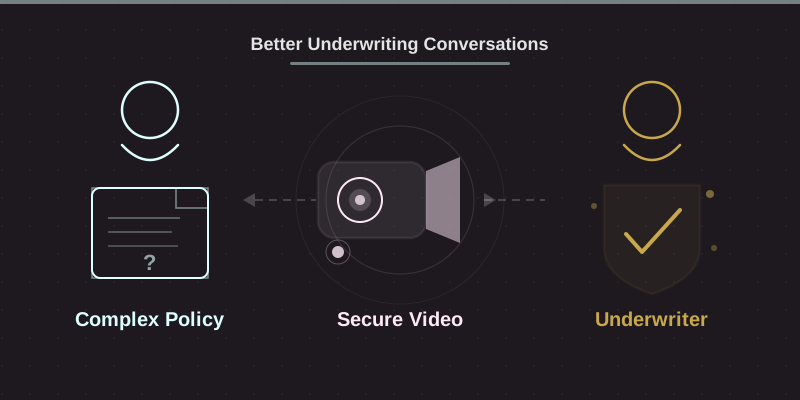
Secure video changes that. Here is how.
Why the Underwriting Conversation Is the Hardest Part of Life Insurance
Let us be honest about what makes a complex retail life insurance policy hard to underwrite.
It is not the actuarial tables. Those are well-established. It is not the data. Most applicants can produce medical records, tax returns, and employer documentation if asked. The difficulty is the conversation that connects those documents to the real person behind them.
Mental health disclosure is the clearest example. APRA and ASIC, at their April 2026 CEO roundtable, confirmed that TPD claims experience has deteriorated across both group and retail markets, driven in particular by the increasing incidence and complexity of mental health related claims. These are real, valid claims. But they are also the category of claims that is hardest to assess accurately through a paper application alone, because the history and context behind a mental health condition varies enormously from one person to the next.
A person who experienced anxiety during a divorce five years ago and has been well ever since is a very different risk profile from someone managing a chronic condition with ongoing medication. A form treats both the same. A conversation does not.
The same applies to complex medical histories, self-employed income verification, occupational hazards in trade or agricultural work, and family medical history disclosures. Every one of these categories requires a back-and-forth exchange to be assessed accurately. Without that exchange, one of two things happens: the underwriter loads the premium to account for uncertainty, or they decline. Either outcome is worse than it needed to be.
And when applicants feel they have been declined or loaded unfairly, they drop out of the insured population entirely. Lapse rates for retail business have continued to outpace new business in the life insurance sector, compounded by increasing mental health claims and cost of living pressure. Poor underwriting conversations contribute directly to this attrition.
What Secure Video Adds to the Underwriting Process
Secure video does not replace underwriting judgment. It gives underwriters and advisers the channel they need to exercise that judgment well.
Here is what changes when an insurer adds structured video to its underwriting workflow for complex retail policies.
The Applicant Can Actually Explain Their History
On a form, the question is: “Have you ever experienced depression, anxiety, or any other mental health condition?” The answer is yes or no. What the form cannot capture is the context that determines what that yes actually means for the risk assessment.
In a video conversation, an underwriter or trained adviser can ask the follow-up questions that matter. How long ago? How was it managed? Has the applicant had any recurrence? Are they currently under the care of a GP or specialist? What does their daily functioning look like? These are the questions that turn a binary disclosure into a risk picture the underwriter can actually work with.
The applicant, for their part, benefits from being able to explain rather than just disclose. Being on camera with a real person who is listening and responding reduces the anxiety that many people feel when facing a medical questionnaire. It also reduces the likelihood of incomplete disclosure, which protects both the policyholder and the insurer when it comes to claims.
Structured, Recorded, and Compliant from the Start
A video underwriting conversation using secure video calling with custom workflows is not an informal chat. It is a structured session with a defined agenda, a compliant recording, and a documented output.
The insurer defines the workflow. The underwriter or adviser follows a consistent discussion guide during the session. The call is recorded and stored securely. The output feeds into the policy file as the documented basis for the underwriting decision. This gives the insurer something a paper form never can: a verbatim, time-stamped record of exactly what the applicant disclosed and how the underwriter responded.
ASIC and APRA are actively reviewing life insurers’ practices around premium increases, product design, and disclosure, with both regulators continuing to engage with individual life companies where uplift is needed. A well-documented video underwriting conversation is compliance infrastructure, not just a customer experience improvement.
APRA’s Prudential Standard CPS 230, introduced in July 2025, requires all regulated entities including insurers to enhance their operational risk management frameworks, particularly in areas like supply chain and claims handling. A recorded, structured video session with a defined workflow directly supports that requirement.
Routing the Right Applicant to the Right Specialist
Not every complex retail policy requires the same specialist. An income protection policy for a rural agricultural worker involves different underwriting expertise than a trauma policy for a professional with a family medical history of cardiac conditions.
The Quality of Advice Review and Delivering Better Financial Outcomes Tranche 2 are creating a more practical pathway for advice to reach consumers, including a new class of advisers focused on simple life insurance conversations. As insurers build out different levels of adviser capability, the ability to route applicants to the right person matters enormously.
Customer journey and routing tools allow an insurer to design the pathway from initial enquiry through to a scheduled video underwriting session with the specialist most suited to the applicant’s profile. A trade worker with an occupational hazard declaration gets routed to the occupational underwriting team. An applicant with a mental health history gets connected with a specialist who is trained in that category of disclosure. This is not just better for the insurer’s risk assessment. It is better for the applicant, who reaches someone who understands their situation rather than a generalist who has to escalate anyway.
Identity Verification for Direct-Sold Policies
Direct-sold life insurance still shows lower acceptance rates and higher dispute incidence than advised business, highlighting the importance of structure and support during the application and claim lodgement process.
Part of the problem in the direct channel is that without a human touchpoint in the process, applicants make poor disclosure decisions, either omitting information because they do not understand its relevance, or abandoning the application entirely because they feel overwhelmed.
Video KYC adds a structured human touchpoint to the direct channel without requiring a branch visit or field agent. A scheduled video session with a trained adviser, conducted via an encrypted live call, allows the insurer to verify the applicant’s identity, walk through the application with them, and create a documented record of the conversation. This closes the advice gap in the direct channel without requiring the applicant to leave their home or workplace.
For applicants in rural and regional Australia, this is particularly significant. There are only around 600 specialist risk advisers left in Australia. The geography of that advisory shortage is not random. It follows population density, which means rural applicants are the least likely to have access to a specialist and the most likely to be applying direct, without guidance.
Video makes the specialist accessible without requiring the specialist to travel.
Ongoing Policy Reviews and Benefit Clarification
The underwriting conversation does not end when the policy is issued. Complex retail life insurance policies require ongoing review as the policyholder’s circumstances change. Income protection policies need to be updated when employment changes. Trauma policies should be reviewed after a family medical diagnosis. Life cover needs adjustment after major life events.
Each of these touchpoints is an opportunity for the insurer to deepen the relationship with the policyholder, reduce lapse risk, and ensure the cover remains accurately priced for the current risk. Each one is also a conversation, not just a form update.
A video branch gives policyholders a direct channel to their insurer for these ongoing conversations, without requiring them to call a generic support line and explain their situation from scratch to whoever picks up. The session is recorded, the update is documented, and the policy record reflects the conversation accurately.
Digital engagement tools that prompt policy reviews around milestone events reduce lapse rates and broaden coverage. A scheduled video review is the highest-quality version of that engagement.
The Underinsurance Problem and the Advice Gap
Australia’s underinsurance gap is not primarily a product problem. The products exist. Income protection, trauma cover, life cover, and TPD policies are well-designed and widely available. The problem is that not enough Australians are having the conversations that would lead them to take out the right cover.
A CALI report found that in 2024, 68 percent of Australians were worried that the cost of living would impact their ability to afford or continue paying for life insurance. That concern is legitimate and understandable. But affordability concerns are also a conversation that can be addressed through advice. A policy that is correctly structured for someone’s actual risk profile is significantly more affordable than a policy that is loaded unnecessarily because the underwriter did not have enough information to assess the risk accurately.
The tradesman in Queensland who abandoned his application was not necessarily uninsurable. He may have been entirely insurable with a specific exclusion for his back condition, at a premium that reflected his actual risk. But he never found out, because there was no conversation to get him there.
Video underwriting conversations, deployed at scale through a platform that routes applicants to the right specialist, records the conversation compliantly, and follows a structured workflow, is the infrastructure that can close that gap. Not for every applicant. But for the complex retail cases where the form alone will always fail.
What Australian Life Insurers Should Look for in a Video Platform
Session recording and secure storage. Every underwriting conversation must be recorded, stored securely within Australia, and accessible to compliance teams. Under the Privacy Act 1988 and APRA’s operational risk standards, this is not optional.
Structured workflow support. The platform must support defined question frameworks for different policy types, so underwriters follow a consistent and defensible process across all video sessions.
Integration with policy administration systems. Video session outputs must feed directly into the insurer’s policy administration and underwriting systems. A separate record that has to be manually transferred introduces error and compliance risk.
Routing logic for specialist teams. The platform must support intelligent routing that connects the right applicant with the right specialist, based on the policy type and disclosed risk factors.
Low-friction access for applicants. No app download. A link sent by SMS or email that opens in the applicant’s browser. The session must work on a standard mobile connection for applicants in regional and rural areas.
Consistent quality regardless of location. Adaptive video quality that maintains the session on lower-bandwidth connections ensures that rural applicants are not disadvantaged by infrastructure gaps.
Frequently Asked Questions
Is a video underwriting conversation legally valid under Australian insurance regulation? Yes. A recorded video session provides a stronger evidentiary record than a written application form for the purposes of disclosure documentation. Under the Insurance Contracts Act 1984 and ASIC’s conduct obligations, the insurer must be able to demonstrate that the applicant was given a proper opportunity to disclose relevant information. A structured video conversation, recorded and stored, satisfies this requirement comprehensively.
How does video underwriting help with mental health disclosure? Mental health disclosures are notoriously difficult to assess through a written form because context is everything. A video conversation allows the underwriter to ask follow-up questions, understand the timeline and treatment history, and assess functional impact in a way that a yes/no form answer cannot support. This leads to more accurate risk assessment and fairer outcomes for applicants whose history is more nuanced than a form allows for.
Can video underwriting be used for direct-sold policies? Yes. Video KYC and structured video sessions can be embedded in the direct channel to provide a human touchpoint without requiring a branch visit or field agent. This is particularly valuable for applicants in regional and rural areas who do not have access to a specialist risk adviser.
How are session recordings stored and who can access them? Under best practice and compliance with the Australian Privacy Act 1988, session recordings must be stored within Australia, encrypted, and accessible only to authorised insurer staff. No session data should remain on the video platform vendor’s servers after transfer to the insurer’s own systems.
Does a video underwriting session require a trained underwriter on the call? This depends on the policy complexity. For straightforward but still complex cases, a trained adviser following a structured workflow can conduct the session and flag specific risk factors for underwriter review. For the most complex cases, a qualified underwriter participates directly. The routing logic determines which resource is assigned to each session.
What happens if the applicant is in a remote area with poor internet? A well-designed video platform adapts automatically to available bandwidth, maintaining the session quality at the best level the connection supports. For applicants with very limited connectivity, the session can be scheduled at a time or location with better access, or the adviser can conduct a preliminary phone conversation to prepare the applicant for the video session.
How does video underwriting support compliance with APRA’s CPS 230 operational risk requirements? CPS 230, introduced in July 2025, requires insurers to enhance their operational risk management frameworks. A structured, recorded video underwriting session with defined workflows and compliant storage creates a consistent, auditable process that supports the documentation and governance requirements under CPS 230.