




Most Australian banks are sitting on a performance problem they cannot fully see.
They have policies. They have training. They have QA processes built around call sampling and periodic coaching. But across distributed branch networks, hybrid teams, and remote servicing models, what actually happens in customer conversations often stays invisible.
Post-interaction video analytics changes that. And for banks operating at scale, it changes quite a lot.
What We Mean by Post-Interaction Video Analytics
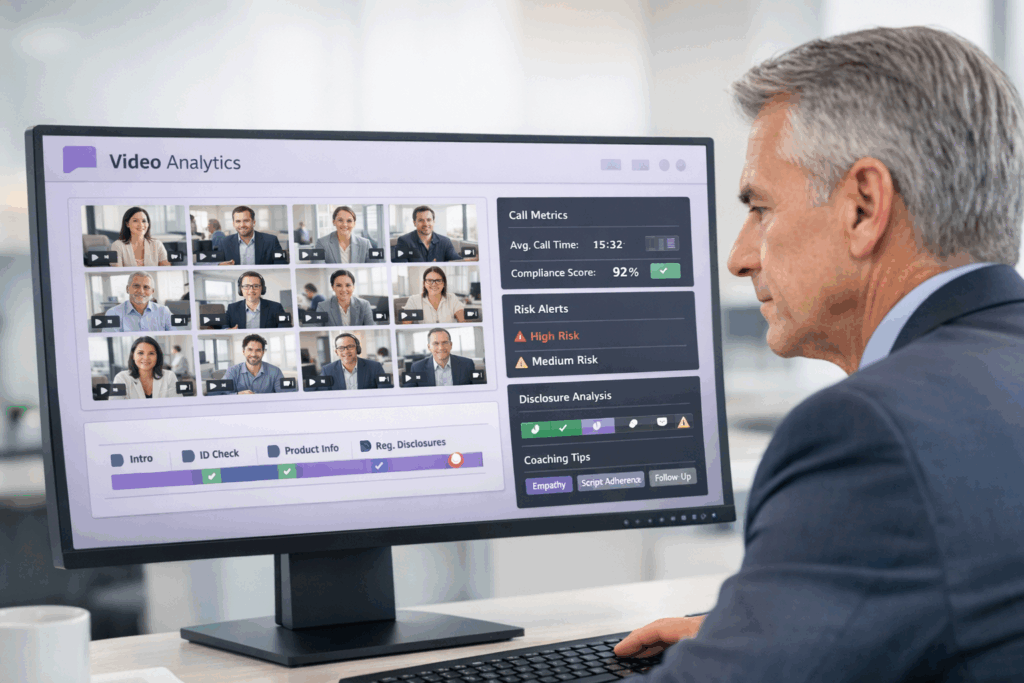
This is not about monitoring agents in real time. It is about systematically reviewing, classifying, and learning from recorded video interactions after they happen.
In a banking context, those interactions include KYC verifications, mortgage conversations, remote advisory sessions, and hardship discussions. Each one carries regulatory obligations, credit judgements, or sensitive customer circumstances. Each one generates richer data than any CRM field or call transcript can capture.
Structured video analytics turns that footage into measurable intelligence. Behavioural signals. Procedural patterns. Disclosure sequencing. Evidence that tells you not just what agents said, but how they said it and whether they followed the right steps.
This is the foundation behind how video branch and video banking infrastructure creates a data layer that telephone and in-person servicing simply cannot match.
A sampled call tells you what one agent did once. Video analytics tells you what your whole network does, consistently.
The Oversight Gap That Most Banks Acknowledge Privately
Here is the honest reality. Most QA models review two to five interactions per agent per month. That is a fraction of a percent of actual customer contact.
The rest goes unreviewed. Uncharacterised. Invisible.
That is a governance problem. It is also a risk problem. The interactions that carry the most institutional exposure are exactly the ones most likely to surface a compliance gap, and the least likely to be caught by sampling.
Distributed agent networks make this worse. Branches in regional centres operate differently from centralised contact teams. Experienced agents develop habits that drift from policy intent. New staff interpret training in ways that look compliant but are not. None of this surfaces until a complaint arrives, or a regulator asks a question you cannot answer cleanly.
USE CASE — Lending / Mortgage
A bank rolls out updated responsible lending training to its home loan team. Three months later, QA sampling shows broadly acceptable results. But post-interaction video analytics across the full population of mortgage conversations tells a different story. Agents in two state-based teams are consistently skipping the income verification discussion before moving to product recommendations. It is not intentional non-compliance, it is a pacing habit developed under volume pressure. Without video analytics across the full interaction set, this pattern stays hidden until a credit event or an ASIC review surfaces it.
What Video Data Actually Reveals
Audio recordings and CRM notes tell part of the story. Video tells much more.
In a lending conversation, you can see whether the agent presented terms in the required order. Whether they gave the customer time to process information before seeking a commitment. Whether they responded to hesitation with care or with pressure.
In a video KYC session, you can confirm that document inspection procedures were followed correctly. That the verification steps matched institutional policy. That the record meets evidentiary standards if a regulator asks for proof.
In a remote advisory session, you can assess whether a wealth adviser disclosed fees and conflicts of interest at the right moment, or whether that disclosure was buried at the end of a forty-minute conversation after the client had already indicated a preference.
For credit verification workflows, video evidence confirms that the PD discussion was conducted correctly, that the agent explored the customer’s financial position thoroughly before any product recommendation was made.
USE CASE — Remote Advisory / Wealth
A national bank expands its remote wealth advisory model post-pandemic. Advisers are conducting video sessions with clients across superannuation, investment, and insurance products. A thematic review using post-interaction video analytics reveals that a subset of advisers is presenting fee structures after product recommendations rather than before, technically within compliance timeframes, but in a sequencing that regulators could reasonably characterise as burying material information. The bank identifies the cohort, adjusts the workflow, and retrains before an external review flags it.
None of this is observable from a transcript or a CRM checkbox. It requires structured video capture, governed from the point of interaction.
Better Coaching. Fewer Assumptions.
The traditional coaching cycle runs on limited evidence. A supervisor listens to a sampled call, identifies something to address, and builds feedback around it. The agent knows the feedback is based on a thin slice of their actual behaviour. The supervisor knows it too.
When coaching draws on video analytics, the evidence base changes entirely.
A team leader can show an agent the specific moment in a lending conversation where the disclosure sequence deviated from policy. They can show a pattern across twelve sessions, not one. They can distinguish between an isolated error and an entrenched habit. That specificity makes the conversation land differently. It feels fair. It is also harder to dispute.
PERFORMANCE OUTCOME — Coaching at Scale
A bank with a 200-person mortgage sales team introduces post-interaction video review as part of its coaching framework. Within two quarters, team leaders report that coaching conversations are materially shorter and more productive, because the evidence is specific rather than general. Agents who previously pushed back on feedback (‘that was just one call’) can no longer dismiss a pattern shown across fifteen interactions. Competency development accelerates. The bank also identifies its top-performing agents and uses their interaction recordings as benchmarks for team-wide training. The improvement compounds.
At scale, the same data reveals which coaching programmes are working, which agent cohorts share common performance gaps, and which training content is failing to produce observable behaviour change. This is where dashboards and reporting become operationally critical and turning individual interaction reviews into network-wide performance visibility for team leaders and senior management alike.
The best-performing agents in your network are already doing something right. Video analytics lets you find out what it is and scale it.
Regulatory Defensibility in the Australian Context
ASIC, APRA, and the legacy of the Royal Commission have shifted regulatory expectations significantly. Conduct outcomes matter as much as process compliance. Institutions must demonstrate that policies are being executed consistently, not just that they exist on paper.
Post-interaction video analytics provides the evidentiary layer that makes this demonstration credible.
When a regulator asks how a particular product was presented to a customer, you want to show the interaction, not reconstruct it from notes and agent recall. When an internal audit team conducts a thematic review of responsible lending conduct across your mortgage network, you want that review to draw on data, not impressions.
The checker module sits at the heart of this. It gives compliance and QA teams a structured workflow for reviewing flagged interactions, so that post-interaction review is not an ad hoc exercise but a governed, repeatable process with an audit trail of its own.
USE CASE — KYC & Regulatory Audit
A bank is subject to an AUSTRAC review of its digital onboarding and KYC procedures. The regulator requests evidence that identity verification steps were conducted in accordance with the bank’s stated compliance programme across a sample of 200 customer onboarding sessions. Because those sessions were captured through a governed video infrastructure with structured metadata, time-stamped verification steps, and a complete audit trail, the bank produces the evidence within days. Banks that conducted the same verifications through unstructured video calls or manual processes spend weeks attempting reconstruction with incomplete results.
For institutions with strict data residency requirements, the on-premise data viewer ensures that interaction records never leave the bank’s own environment. A non-negotiable for many Australian institutions operating under APRA’s prudential data governance standards.
A governed, time-stamped video record is materially stronger than an attestation. It shifts your position in a regulatory inquiry from inference to evidence. That is a genuine institutional advantage and it compounds over time as the data set grows.
Connecting CX, Credit Quality, and Compliance
Here is a structural problem that affects most large banks. Customer experience, credit quality, and compliance are measured through separate frameworks. They rarely share data.
A high satisfaction score from a lending conversation can coexist with a disclosure that did not meet responsible lending expectations. A low complaints rate from a collections team can obscure conduct patterns that carry real exposure. Siloed measurement produces a partial picture.
Structured video analytics creates a shared data layer. The same interaction record informs a compliance review, a credit quality assessment, and a CX evaluation. Leadership across all three functions works from the same evidence. Disagreements about where the gaps are become resolvable with data rather than competing internal narratives.
The same applies to adjacent product lines. Insurance policy servicing conversations carry their own disclosure obligations and conduct risk profile. When those interactions are captured and reviewed through the same governed infrastructure, banks with diversified product portfolios get a consistent performance picture across every customer-facing channel, not just the ones that have historically attracted the most scrutiny.
The Infrastructure Requirement Behind the Strategy
Everything described here depends on one foundational requirement. Video interactions must be captured within structured, governed workflows, not through general-purpose conferencing tools or consumer platforms.
An institution applying post-interaction analytics to footage from Zoom or Teams faces immediate challenges in data sovereignty, metadata integrity, access control, and chain of custody. The evidentiary value of footage that cannot be verified as unedited, or that sits outside a sovereign cloud environment, is significantly reduced.
VideoCX.io is built specifically for this operating environment. The platform captures video interactions across onboarding, KYC and identity verification, lending and mortgage conversations, remote advisory sessions, and high-sensitivity collections discussions within structured workflows that enforce sequencing, documentation, and metadata requirements from the outset.
It provides the data sovereignty configurations and access control architecture that Australian banks require. And it makes post-interaction analytics viable across a national operation, not just a pilot team or a single business line.
Why This Matters Now
Australian banks have invested heavily in data analytics across credit decisioning, fraud detection, and customer segmentation. The application of structured analytics to agent performance has lagged because the underlying data has been thin, unstructured, and impossible to review at scale.
Post-interaction video analytics closes that gap.
It gives institutions a way to see what is actually happening across their frontline networks. To coach with evidence. To govern with confidence. To meet regulatory scrutiny with something better than a reconstruction.
The examples in this article are not edge cases. They are the kinds of situations that surface in every major bank, every year. The difference is whether you find out early through structured analytics or late through a complaint, a credit event, or a regulator’s letter.
The technology to do this in a compliant, institution-grade way already exists. The question is how quickly Australian banks choose to use it.